Artists explore science and survival; a geological cabaret; quantum comics; crafting the gut-brain connection
Great National Science Week ARTS stories up for grabs now around Australia
- Flying fox inspired installation explores life after collapse – Dandenong, VIC
- Striptease meets ‘dirty’ science – Canberra, ACT
- Patricia Piccinni and other artists adapt to survive in new Science Gallery exhibition – Parkville, VIC
- Step inside a giant, woolly gut – Sydney, NSW
- Planetarium concert explores music, misinformation, and the cosmos – Brisbane, QLD
- Researchers and teenage artists create art together – Hobart, TAS
- Quantum physics and life collide in The Friendship Paradox – Brunswick East, VIC
- A First Nations astrophysicist reads the art at the NGA – Parkes, ACT
- From stone circles to space telescopes – Sydney, NSW
- Four artists dive into the science of water – Sale, VIC
- The invisible animals holding our waterways together – Box Hill, VIC
- The sound of cosmic collisions: a musical exploration of space-time – Canberra, Wollongong, Sydney, Newcastle, Adelaide, Brisbane & online
More on these below and visit ScienceWeek.net.au/events to find more stories in your area.
Scientists, experts, performers and event organisers are available for interview throughout National Science Week.
Read on for direct contact details for each event, or contact Tanya Ha, tanya@scienceinpublic.com.au or 0404 083 863.
Individual event details and media contacts
Flying fox inspired installation explores life after collapse – Dandenong, VIC
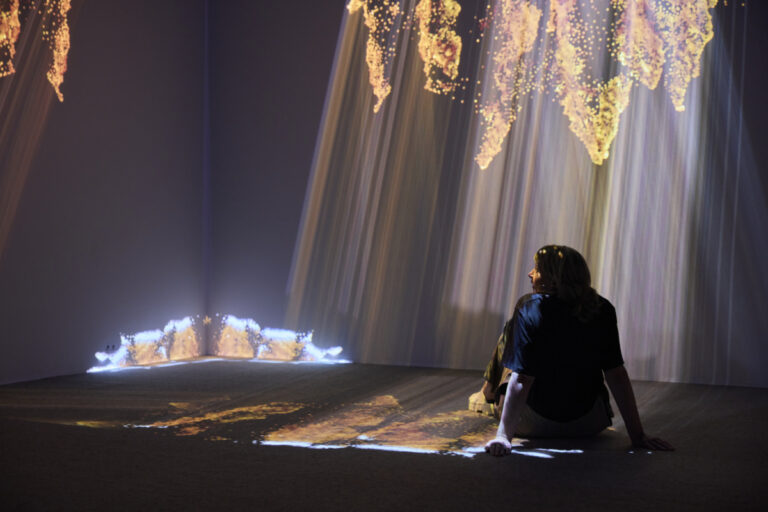
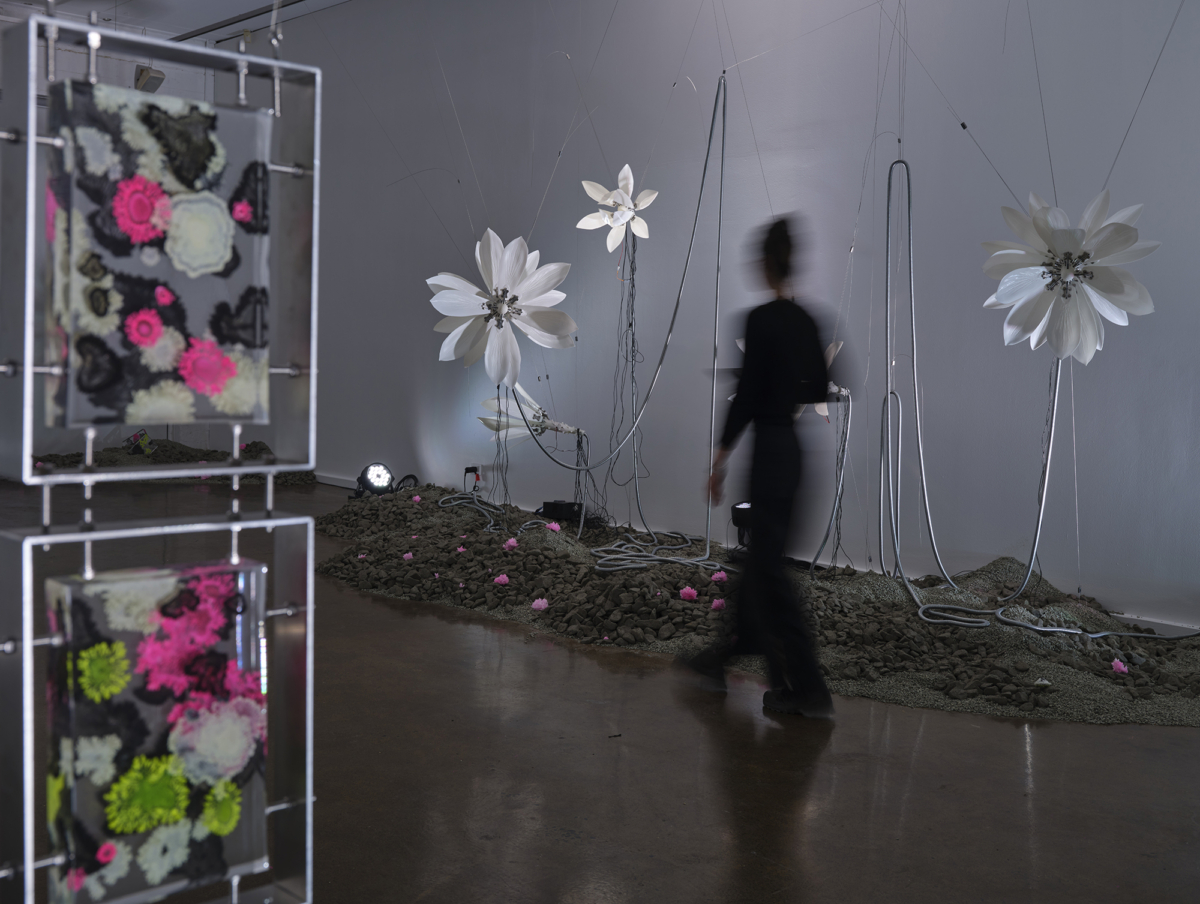
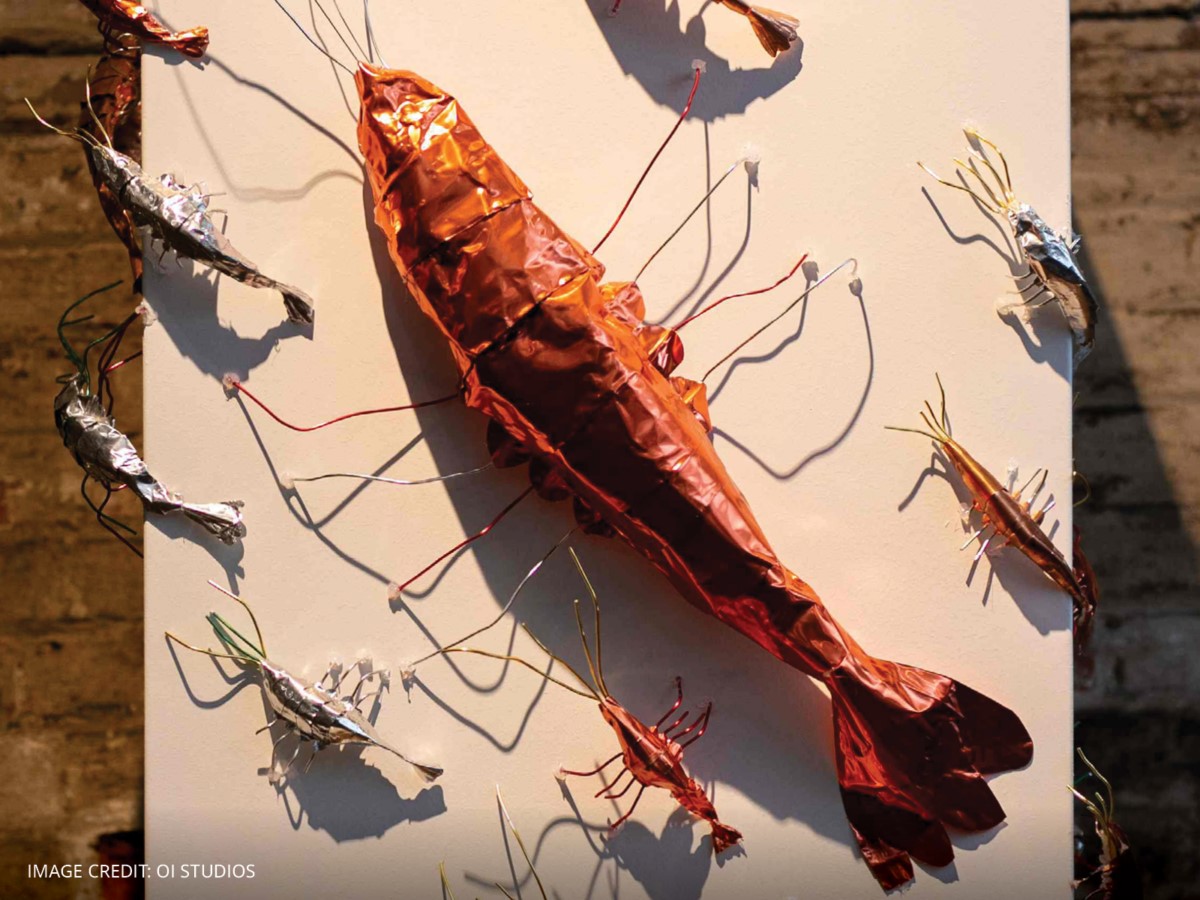
Artists Charlie Lawler and Wona Bae invite audiences to explore ecosystem science through contemporary art.
Their installation ‘Primary Succession’ explores environmental loss through the lens of one of the region’s most vital yet often misunderstood species: the grey-headed flying fox.
Essential pollinators and seed dispersers, these nocturnal animals function as a keystone species whose survival is closely tied to the health and regeneration of entire ecosystems. The artists imagine a future where eco-intelligence and ecological memory replace human-centred systems of control.
Grounded in long-term research into Melbourne and Greater Dandenong landscapes, the work examines a world shaped by colonial extraction, urban expansion and climate crisis. It reflects on how life reorganises itself after ecological rupture.
The project brings together technical partners including Chisholm Institute, Swinburne University of Technology, and RMIT’s Future Play Lab; and conservation partners, including the Royal Botanic Gardens Cranbourne and the Bunurong Land Council Aboriginal Corporation.
Saturday 15 August – Saturday 22 August. Event details: www.scienceweek.net.au/event/wona-bae-and-charlie-lawler-primary-succession/dandenong/
Media enquiries: Arts in Greater Dandenong, arts@cgd.vic.gov.au or 03 8571 5320.
Striptease meets ‘dirty’ science – Canberra, ACT
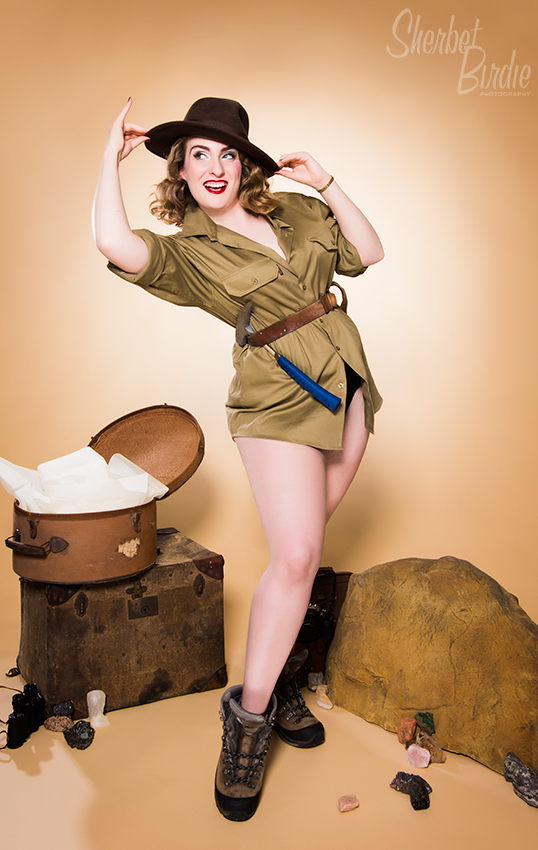
Canberran researcher Dr Karina Judd presents a smart, sexy, adults-only exploration of geological and earth sciences.
By day, Dr Judd conducts science-engineering-social science research at the Australian National University to make the zero-carbon transition more people-friendly.
By night, she moonlights as ‘Roxie’ in her one-woman cabaret Rock Hard! The Geological Cabaret , winning the 2026 Science at the Fringe Award.
“Funny and bold … an enjoyable learning experience!” – judge’s comments, Adelaide Fringe Festival.
What to expect? Cocktail hour geology with sultry songs, smouldering dance, sharp wit and a shimmer of burlesque. No safety glasses required.
Friday 14 – Saturday 15 August. Event details: www.scienceweek.net.au/event/rock-hard-the-geological-cabaret-2/canberra/
Media enquiries: Dr Karina Judd, karina.judd@gmail.com or 0448 318 748.
Dr Judd, who wrote and produced Rock Hard! The Geological Cabaret, is available for media interviews. She studied environmental geology at UNSW Sydney, specialising in soil and mineral chemistry before completing Honours in geology showcasing soil chemistry techniques as a useful tool in identifying past tsunami. And she is a seasoned performer of cabaret, burlesque and dance. See ANU profile: https://cpas.anu.edu.au/people/karina-judd
Patricia Piccinni and other artists adapt to survive in new Science Gallery exhibition – Parkville, VIC
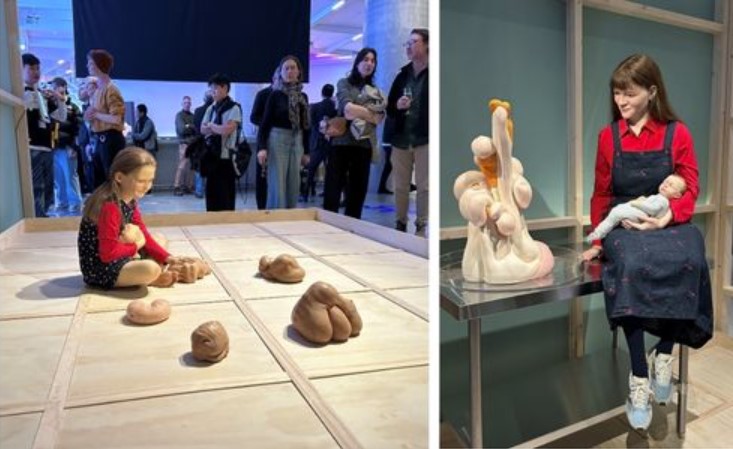
Patricia Piccinni spent a year immersed in stem cell research laboratories to create Células Madre, which revisits her seminal early work Still Life with Stem Cells. US artist David Bowen uses wind data collected from the Perseverance Mars rover to make tele-present wind, while designer and academic Alia Parker grew vats of fungal leather for her collection of modern mushroom clothing that is naturally fire-retardant, hydrophobic and compostable.
These collisions of art and science are all part of EMERGENCE(Y), an exhibition at the University of Melbourne’s Science Gallery that explores how humanity can adapt in the face of environmental, social and political collapses.
Saturday 15 to Saturday 22 August. Event details: www.scienceweek.net.au/event/emergencey/parkville-vic-3052
Media enquiries: Katrina Hall, kathall@ozemail.com.au or 0421 153 046
Exhibition curator Tilly Boleyn, Australian designer and academic Alia Parker and US artist David Bowen are available for media interviews.
Step inside a giant, woolly gut – Sydney, NSW
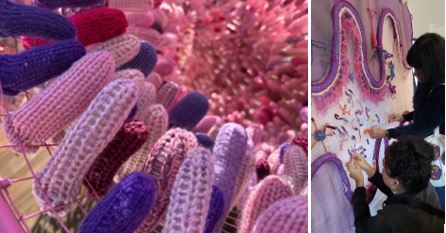
Textile artists and community members have knitted a giant walk-in gut to explore the gut microbiome and its impact on mental health.
It’s part of the ‘Gut Feelings’ exhibition, the brainchild of three artists behind a collaborative science-based crafting initiative that builds on the success of the Neural Knitworks project.
For the past three years, the team has presented workshops and informal knit and stitch sessions across Sydney. This has brought people of all ages and abilities together to create textile microbes and intestinal villi and find out about the gut-brain connection.
Community members involved in ‘Gut Feelings’ have engaged with researchers and followed scientifically-informed patterns to knit, crochet, weave and stitch more than 4,000 villi, 450 gut epithelial cells, hundreds of microbes. The result is an exhibition of artworks, including:
- a giant soft sculpture gut filled with knitted villi,
- a life-size crochet silhouette of the body showing the gut-brain connection via the vagus nerve, and
- a crochet version of the Bristol Stool Chart.
Researchers who participated in the project are from UNSW Sydney, University of Sydney, University of Technology and ANSTO.
A workshop at Five Dock Library and free exhibitions at St George Hospital’s Atrium and the Indigenous Science Experience at Redfern will immerse visitors in ‘a playful yet serious’ exploration of the gut-brain axis.
Media enquiries: Pat Pillai, gutfeelingsartproject@gmail.com or 0408 213 844; Mary Hyman, 0424 100 597.
Lead artist Pat Pillai and art educator Mary Hayman are available for interviews.
Planetarium ‘pop-rock-funk’ concert explores music, misinformation, and the cosmos – Toowong, QLD
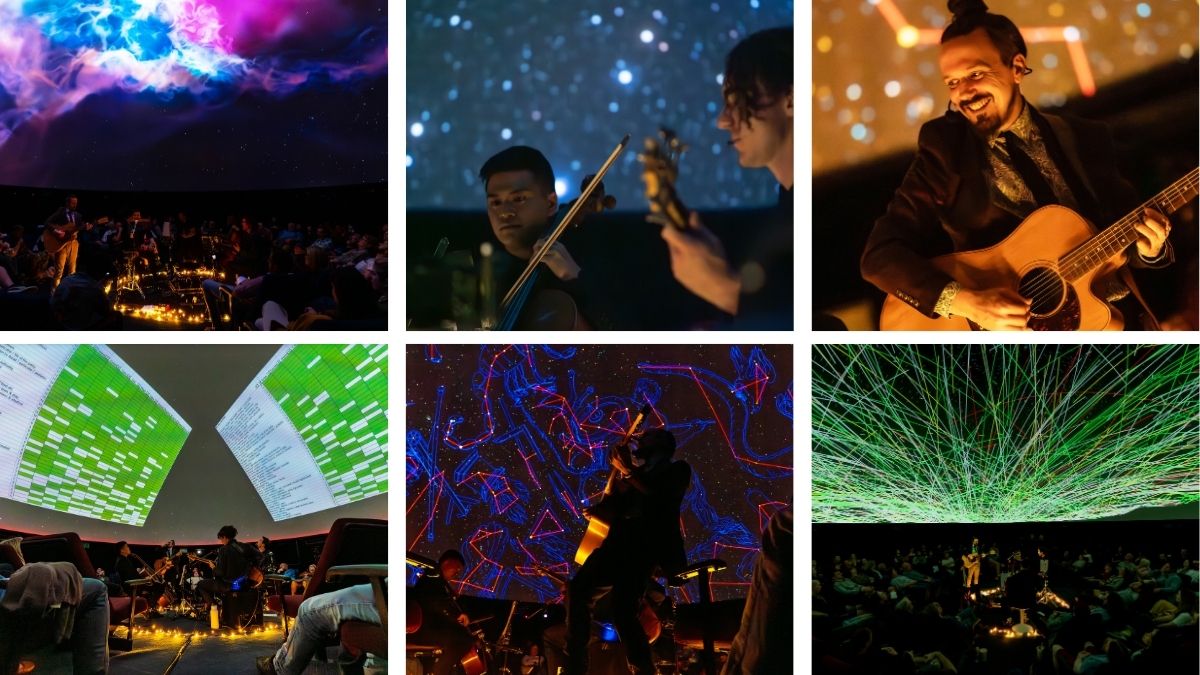
Nate Eggins (a.k.a. Conspiracy of One) is returning with his unique Planetarium Variety Show for an evening of:
- Quirky sciency songs like ‘We’re All Aliens, Baby’ and ‘The Sound a Duck Makes’, funny rants and audience participation and prizes
- Stunning planetarium visuals
- A workshop on critical thinking and the chance to contribute data to an ongoing study,
- Special guest: Science Communicator Melanie Trecek-King of Thinking is Power and author of the upcoming book A Field Guide to Spotting Misinformation .
Returning to the cosmic skydome are Nate and his band to bring you a special stripped back and intimate performance including songs from his debut album ‘Road to Reason’.
Audiences will gain new and interesting perspectives on science and our modern world, level up your thinking and learn how to spot pseudoscience pretenders – all while tapping their feet.
Friday 21 August. Event details: www.scienceweek.net.au/event/planetarium-concert-live-music-in-the-skydome-3/toowong/
Media enquiries: Nate Eggins, nathan@sentientproductions.com.au or 0402 593 431.
Nate Eggins is available for media interviews. Footage and photos available here .
Researchers and teenage artists create art together – Hobart, TAS
Beaker Street’s CoLab initiative pairs research scientists with high-school art students, who visit labs and field sites to create artworks that communicate scientific concepts. The results go on show in the free CoLab exhibition.
Students from New Norfolk High School, Hobart Big Picture School and Hobart City High School worked directly with local scientists to make the work. On show during TMAG’s opening hours and during TMAG After Dark on Friday 14 and Saturday 15 August.
Runs 6–13 August.Event details: www.scienceweek.net.au/event/beaker-street-science-photography-prize-finalist-exhibition-2/hobart
Media enquiries: Matt Fraser, matt@moxee.au or 0401 326 007.
Quantum physics and life collide in The Friendship Paradox – Brunswick East, VIC
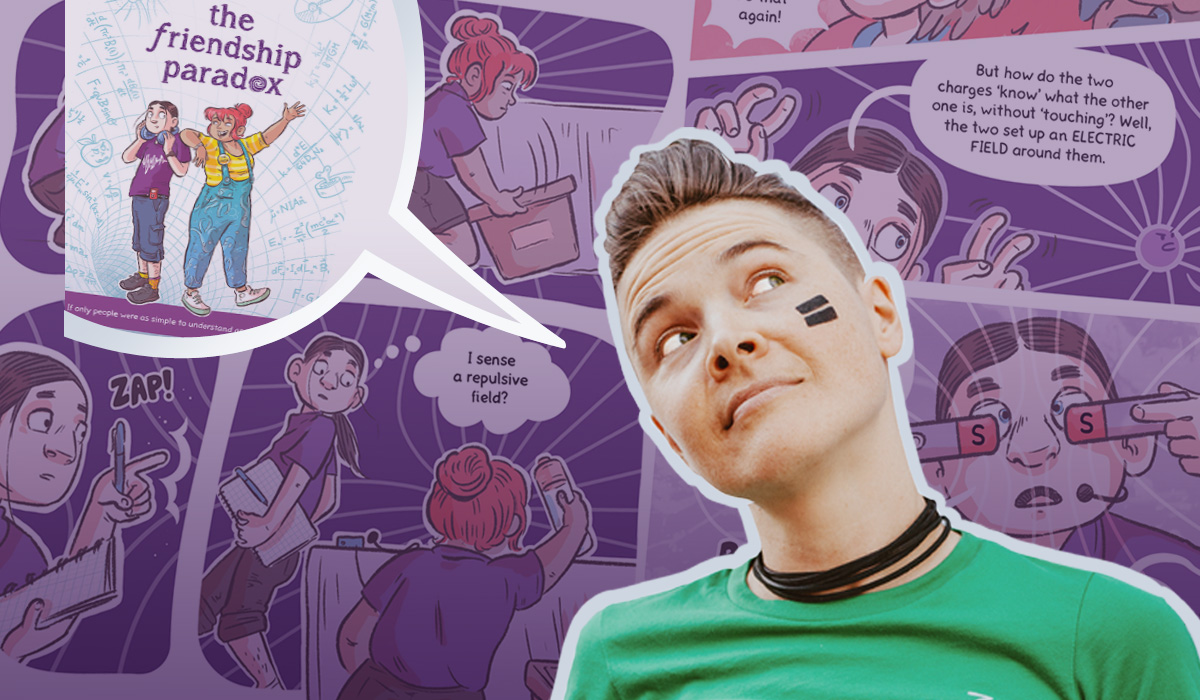
In The Friendship Paradox (Allen & Unwin 2026) scientist-turned-artist Aśka (pronounced Ash-ka) tries to use physics to navigate life. Aśka is launching their latest graphic novel with a workshop teaching teens how very simple drawings can capture movement, emotion and some complicated ideas.
Aśka’s previous title Stars in Their Eyes (Scholastic, 2023) was a 2024 CBCA Notable Book, Stonewall Honor Book and nominated for the Comic Arts Awards of Australia.
Monday 10 August. Event details: www.scienceweek.net.au/event/the-science-of-comics-draw-ideas-bend-brains-in-a-good-way/brunswick-east
Media enquiries: Michael Earp, michael@littlebookroom.com.au or 03 7048 4703.
Aśka (she/they) is available for media interviews.
A First Nations astrophysicist reads the art at the NGA – Parkes, ACT
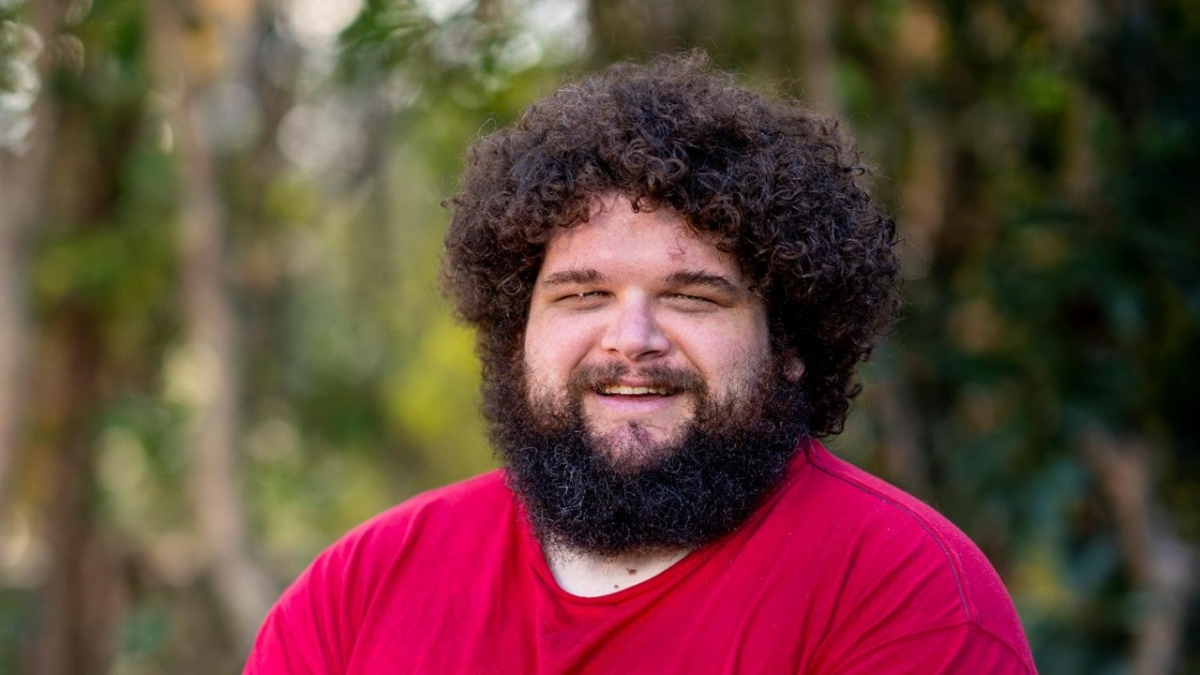
First Nations astrophysicist and cultural astronomer Peter Swanton will walk the National Gallery of Australia responding to works in the National Collection – and in Ngura Puḷka: Epic Country – tracing the links between contemporary science, visual art and the world’s oldest living continuous culture.
A Gamilaraay and Yuwaalaraay man, Swanton began his research in black holes and cosmology before shifting to cultural astronomy and dark-sky preservation. His work highlights the scientific importance of Indigenous star knowledges and the threat of light pollution
Friday 14 August.Event details: www.scienceweek.net.au/event/dark-sky-stories-and-art-art-vs-science-friday-art-talks/parkes
Media enquiries for Peter Swanton: media@anu.edu.au or 02 6125 7979
Event organiser: National Gallery of Australia, learning@nga.gov.au or 02 6240 6411.
From stone circles to space telescopes – Kensington, NSW
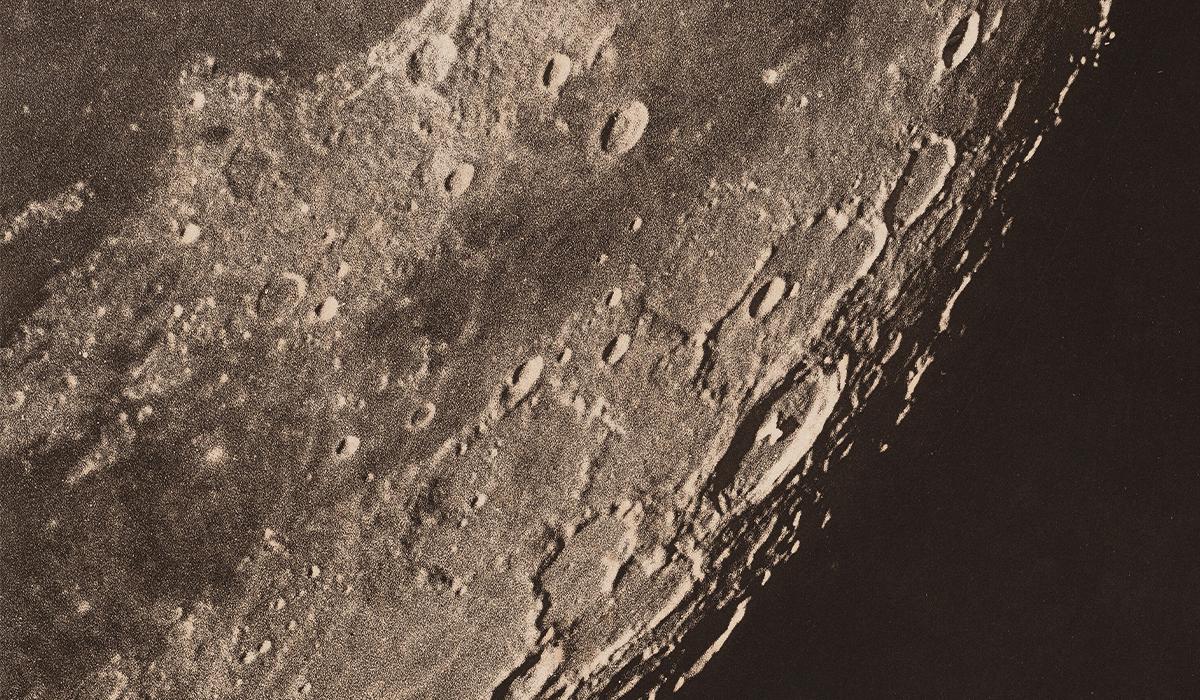
‘The Infinite Look: A History of Gazing Skyward’ examines humanity’s long relationship with the cosmos through the instruments built to study it – from ancient stone observatories tracking the sun and moon to the James Webb Space Telescope – alongside the cultural traditions that give the night sky meaning.
Curated by UNSW Library with the School of Physics and the School of Biological, Earth & Environmental Sciences, the exhibition draws on UNSW’s archives, art collection and scientific instrument museum, and features artworks by Timothy Cook, Anissa Jones, Sylvia Kanytjupai Ken, Glen Mackie (Kei Kalak), Segar Passi and Abdullah M.I. Syed.
The exhibition acknowledges First Nations Elders and recognises Sky Country as a vital extension of land and sea – a map of knowledge, spirituality and science underpinning the oldest living culture on Earth.
Saturday 15 – Thursday 20 August.Event details: www.scienceweek.net.au/event/the-infinite-look-a-history-of-gazing-skyward/kensington
Media enquiries: Giulia Giorgi, g.giorgi@unsw.edu.au or 0424 146 714
Four artists dive into the science of water – Sale, VIC

Four Gippsland-based artists – Lesley Duxbury, Elisabeth Scott, Peter Cummings and Lotje McDonald – open a major exhibition on the theme of “Water” at the Bond Street Event Centre, exploring the subject across cultural, societal, philosophical and scientific perspectives.
The opening night includes an artist talk and panel discussion, with all four artists on the panel, encouraging conversation between artists and audience about how they use design, colour, symbolism and metaphor to convey meaning. The ticket includes supper; bookings are essential.
Friday 14 August.Event details: www.scienceweek.net.au/event/water-exhibition-opening-exhibition-and-engaging-panel-discussion/sale
Media enquiries: Allison Yanez, The Bond Street Event Centre, allisonabern@hotmail.com or 03 5182 8770.
The invisible animals holding our waterways together – Box Hill, VIC

Drawing on more than 20 years in aquatic micro-invertebrate ecology, Dr Robert Walsh reveals the microscopic organisms – the zooplankton smaller than 2mm – that underpin aquatic food webs and sustain larger ecosystems.
Artist Emma X Zhang brings these unseen realms into view through microscopic image-stacking, processed prints, fabric works and light installations in her exhibition After-Image. Together they explore how a fusion of science and art can make the invisible not only visible but felt.
Deep Dive features an exhibition tour and a presentation on aquatic organisms and ecosystems.
Tuesday 18 August.Event details: www.scienceweek.net.au/event/deep-dive-art-and-aquatic-ecology-with-dr-robert-walsh-and-emma-x-zhang/box-hill
Media enquiries: Marguerite Brown, Whitehorse Art Gallery, marguerite.brown@whitehorse.vic.gov.au or 03 9262 6250
The sound of cosmic collisions: a musical exploration of space-time – Canberra, Wollongong, Sydney, Newcastle, Adelaide, Brisbane & online
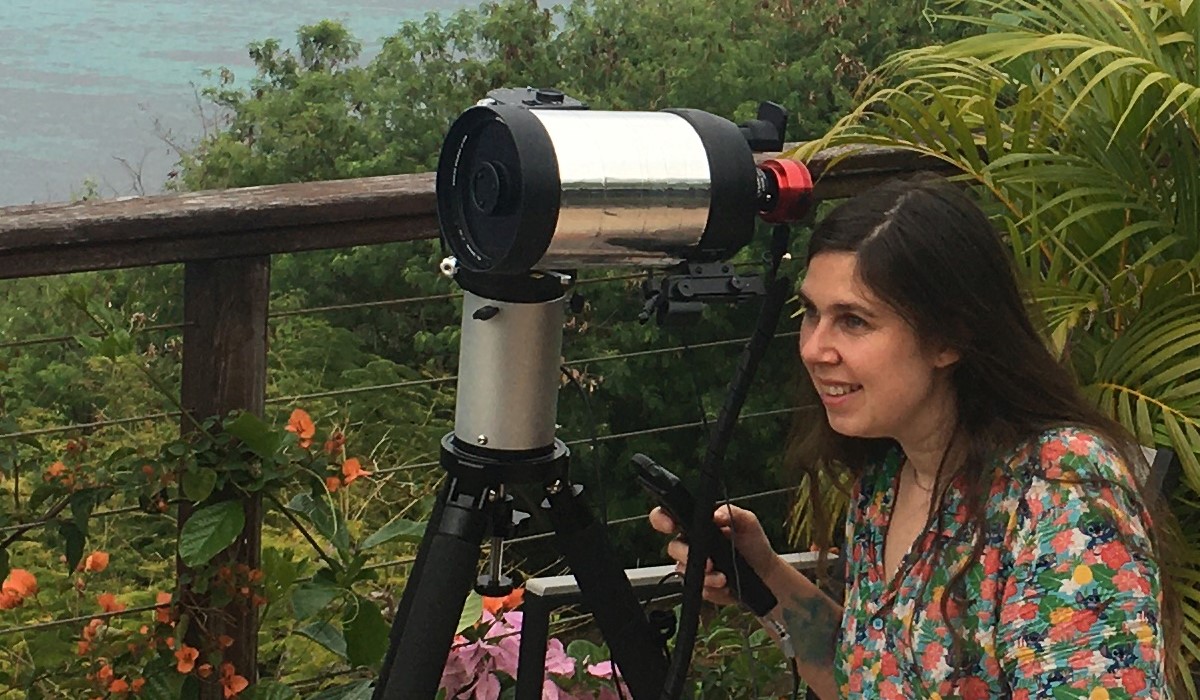
The most violent events in the universe create elements such as gold, platinum and the iodine in human blood. Dr Karelle Siellez is listening to the aftermath of these massive kilonova through electromagnetic radiation ad gamma-ray bursts. She will explore the ‘sound’ of cosmic collisions, and what these signal reveal about the universe, during public talks across the country as part of the 2026 Marie Curie lecture series.
Karelle is an astrophysicist and lecturer at the University of Tasmania. She contributed to the first detection of a gamma-ray burst and gravitational waves from the same cosmic event, recognised with the 2017 Breakthrough Prize. She is also an award-winning science communicator who integrates art, sound, and storytelling into her work.
Media enquiries: Dr Karen Livesey and Dr Karen Siu (Marie Curie Tour Co-ordinators), wip@aip.org.au, 0478 260 533