Skip to content
Science in Public
  • Home
  • About usExpand
    • Our team
    • Our portfolio
  • Our servicesExpand
    • Writing and editing
    • Communication support
    • One-to-one consulting
    • Video production
    • Media for conferences
  • Our clients
  • Media Training
  • National Science Week
  • Media releases
  • Newsletters
Contact
Science in Public
  • Volcanic bubbles help foretell the fate of coral in more acidic seas
    Australian Institute of Marine Science Media releases

    Volcanic bubbles help foretell the fate of coral in more acidic seas

    24 November, 202527 November, 2025

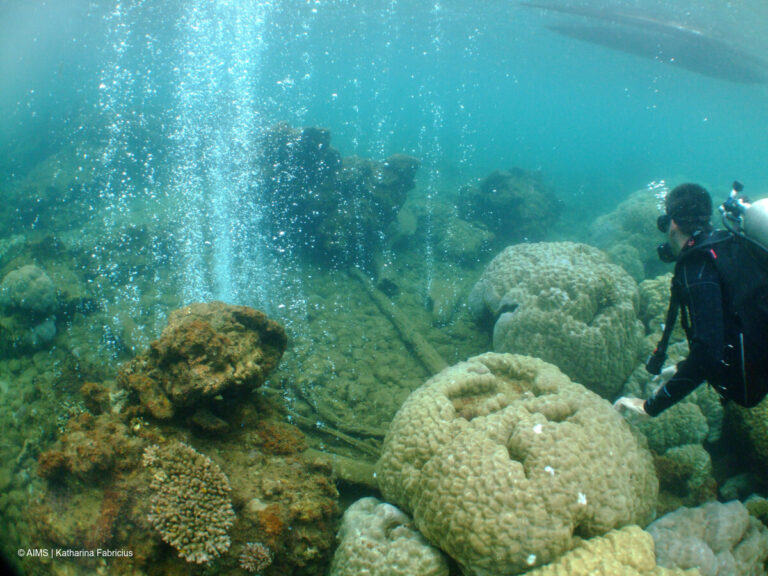
    By 2100 Australian and global coral reef communities will be slow to recover, less complex, and dominated by fleshy algae, as high carbon dioxide changes ocean chemistry. An international study published today in Communications Biology has used unique coral reefs in Papua New Guinea to determine the likely impact of ocean acidification on coral reefs in the face…

    Read More Volcanic bubbles help foretell the fate of coral in more acidic seasContinue

  • Australian Institute of Marine Science Media releases

    Cyclones can damage even distant reefs

    28 May, 20201 December, 2020

    Research finds current models underestimate the impact of hurricanes and typhoons on coral reef communities Full paper and images available. Details below. Big and strong cyclones can harm coral reefs as far as 1000 kilometres away from their paths, new research shows. A study led by Dr Marji Puotinen from the Australian Institute of Marine Science (AIMS)…

    Read More Cyclones can damage even distant reefsContinue

  • Australian Institute of Marine Science Media releases

    Fish faeces reveals which species eat crown-of-thorns

    18 May, 20201 December, 2020

    Great Barrier Reef research finds the destructive starfish is eaten more often than thought. Full paper, video, gifs and still images available. Details below. Crown-of-thorns starfish are on the menu for many more fish species than previously suspected, an investigation using fish poo and gut goo reveals. The finding suggests that some fish, including popular…

    Read More Fish faeces reveals which species eat crown-of-thornsContinue

  • Australian Institute of Marine Science Media releases

    Additions to resource industry underwater robots can boost ocean discoveries

    15 April, 20201 December, 2020

    Remotely operated vehicles used by the oil and gas sector can be enhanced to gather more scientific data, researchers say. Underwater robots are regularly used by the oil and gas industry to inspect and maintain offshore structures. The same machines could be adapted to gather extra scientific information, thus boosting environmental and resource management capabilities,…

    Read More Additions to resource industry underwater robots can boost ocean discoveriesContinue

  • Australian Institute of Marine Science Media releases

    Cold War nuclear bomb tests reveal true age of whale sharks

    6 April, 20201 December, 2020

    The radioactive legacy of the arms race solves a mystery about the world’s largest fish. Atomic bomb tests conducted during the Cold War have helped scientists for the first time correctly determine the age of whale sharks. The discovery, published in the journal Frontiers in Marine Science, will help ensure the survival of the species…

    Read More Cold War nuclear bomb tests reveal true age of whale sharksContinue

  • Australian Institute of Marine Science Media releases

    Sharp increase in Ningaloo whale shark injuries might be due to boat encounters

    24 January, 202017 March, 2020

    Scarring and major lacerations due to vessel collisions becoming more common, study finds. Almost one-fifth of the whale sharks (Rhincodon typus) in Western Australia’s Ningaloo Reef Marine Park show major scarring or fin amputations, with the number of injured animals increasing in recent years, new research reveals. Distinctive scar patterns strongly suggest many of the…

    Read More Sharp increase in Ningaloo whale shark injuries might be due to boat encountersContinue

  • Australian Institute of Marine Science Media releases

    When reefs decline, parrotfish thrive

    3 December, 201919 February, 2020

    Researchers find familiar species pave the way for coral regrowth In contrast to most other species, reef-dwelling parrotfish populations boom in the wake of severe coral bleaching. The surprise finding came when researchers led by Perth-based Dr Brett Taylor of the Australian Institute of Marine Science (AIMS) looked at fish populations in severely bleached areas…

    Read More When reefs decline, parrotfish thriveContinue

  • Australian Institute of Marine Science Media releases

    Corals already have the genes to adapt to warmer oceans

    26 June, 201529 June, 2015

    Townsville and Texas researchers discover a genetic basis to temperature tolerance in coral. And it likely depends on ‘mum’s genes’. Media resources: Media release and background information below High res images Authors available for interview (details below) Footage of the reef (below) Working journalists can request copies of the embargoed Science paper from the AAAS…

    Read More Corals already have the genes to adapt to warmer oceansContinue

  • Australian Institute of Marine Science Media releases

    Corals already have the genes to adapt to warmer oceans – images

    26 June, 201529 June, 2015

    Media release and background information High res photos (below) Working journalists can request copies of the embargoed Science paper from the AAAS Office of Public Programs, on +1-202-326-6440 or scipak@aaas.org. Others seeking copies of the paper may order them from www.sciencemag.org Please click on an image to access the high resolution version.

    Read More Corals already have the genes to adapt to warmer oceans – imagesContinue

  • Australian Institute of Marine Science

    University of Texas at Austin release

    17 June, 201530 June, 2015

      Corals are already adapting to global warming, scientists say AUSTIN, Texas — Some coral populations already have genetic variants necessary to tolerate warm ocean waters, and humans can help to spread these genes, a team of scientists from The University of Texas at Austin, the Australian Institute of Marine Science and Oregon State University…

    Read More University of Texas at Austin releaseContinue

Page navigation

1 2 3 Next PageNext

© 2026 Science In Public - WordPress Theme by Kadence WP

Linkedin Bluesky Facebook Twitter
  • Home
  • About us
    • Our team
    • Our portfolio
  • Our services
    • Writing and editing
    • Communication support
    • One-to-one consulting
    • Video production
    • Media for conferences
  • Our clients
  • Media Training
  • National Science Week
  • Media releases
  • Newsletters