
Stories of Australian
quantum science
Highlights from our work supporting Australia’s quantum community.
Over the past twenty years, Science in Public has told the story of Australia’s growing quantum science community.
Some of the highlights include…
Quantum Australia
In 2026, we were commissioned to write two series of stories for Quantum Australia, the national industry growth centre for quantum technology
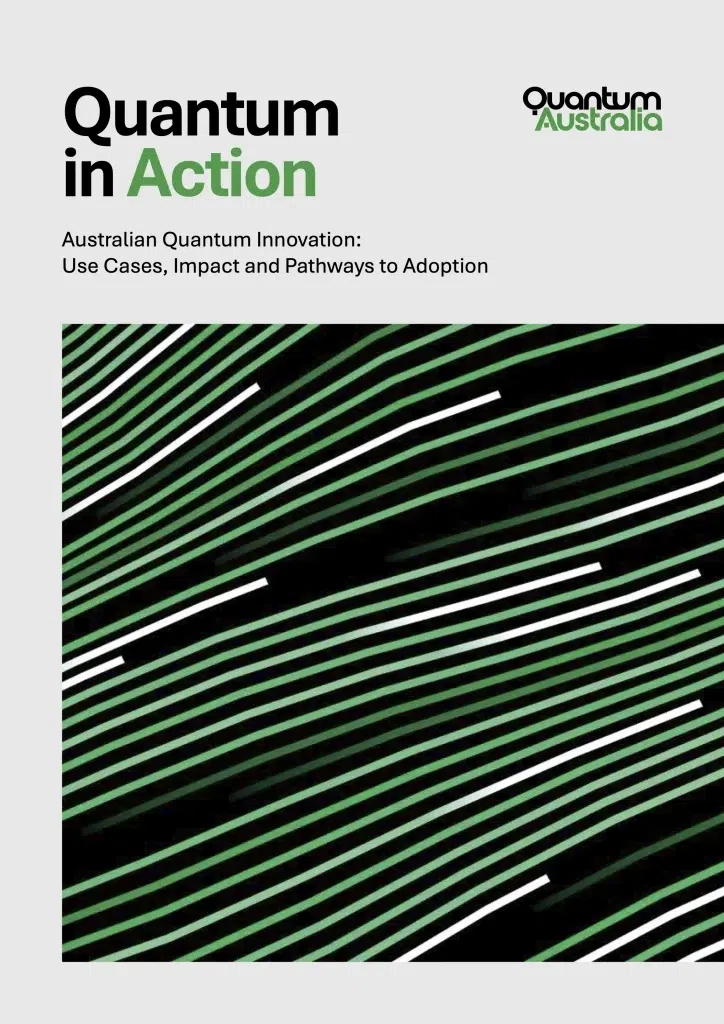
Quantum in Action: Australian Use Cases
This brochure features the following company profiles written by Science in Public on:
Startup spotlights
A series of five features for Quantum Australia’s website.
Quantum Lock: trust nothing, prove everything
A UNSW spin-out is planning to use entangled photons to prove that the computers running power stations and other critical national and defence infrastructure haven’t been compromised. READ
GridState Photonics: using light to beat errors
A two-person Brisbane start-up is betting that the key to a useful quantum computer isn’t building more qubits — it’s needing fewer of them for every reliable one. READ
The diamond sensor that could end years of iron misdiagnosis
Melbourne quantum start-up FeBI Technologies is targeting a blood test that hasn’t changed in decades – developing new technology to identify the one in three women currently misdiagnosed. READ
The fastest route or the best? QFactorial is building logistics software that aims for both
Quantum-ready optimisation software, delivering value on classical computers today and designed for the quantum hardware coming next. READ
Physics, not maths: Space CoLAB’s bet against quantum hackers
A room-temperature, diamond-based quantum communications system designed so that if someone intercepts the signal, they get nothing at all. READ
News Stories
-
Australia’s quantum edge: the unseen engine powering sovereign capability
Australia’s leadership in quantum science is no accident. It is the product of decades of bipartisan Federal Government investment in research, matched with sustained support for the critical infrastructure that enables discovery to move from theory to application. At the heart of this effort is the National Collaborative Research Infrastructure Strategy (NCRIS), a long-term commitment to…
-
Welcome to Quantum Year
Marking the first 100 years of the quantum era And the beauty of the science that we use daily to connect with the world, light our homes, fight disease, and scan our groceries. The UN has declared 2025 as the International Year of Quantum Science and Technology. The Year will be launched on 4 February…
-
Quantum computing in silicon hits 99 per cent accuracy
UNSW Sydney-led research paves the way for large silicon-based quantum processors for real-world manufacturing and application. Images and media kit download Australian researchers have proven that near error-free quantum computing is possible, paving the way to build silicon-based quantum devices compatible with current semiconductor manufacturing technology.
-
Building a silicon quantum computer chip atom by atom
An atomic array in silicon paves the way for large scale devices Video and images: direct link A University of Melbourne led team have perfected a technique for embedding single atoms in a silicon wafer one-by-one. Their technology offers the potential to make quantum computers using the same methods that have given us cheap and…
-
Hot qubits made in Sydney break one of the biggest constraints to practical quantum computers
A proof-of-concept published in Nature promises warmer, cheaper and more robust quantum computing. And it can be manufactured using conventional silicon chip foundries. Full media kit here. Most quantum computers being developed around the world will only work at fractions of a degree above absolute zero. That requires multi-million-dollar refrigeration and as soon as you…
-
Australian Institute of Physics | Australian Institute of Physics Congress | Media releases | Quantum
How close is a quantum computer?
Quantum computers promise ultra-powerful, high speed number crunching. They’ll help us to search vast databases and model biological molecules at an atomic level.

How can we help you?
Niall Byrne +61 417 131 977 | niall@scienceinpublic.com.au
Sarah Brooker on +61 413 332 489 | sarah@scienceinpublic.com.au
During the Microsoft outage, please text us.
Our team are located in Adelaide, SA and Melbourne, VIC.